
5 Keys for a High-Performance Data Model
Mastering the Engine Room

Investment banking was not fun.
The hours are long, the models are brittle, and your capacity for processing information inevitably hits a ceiling. My obsession with escaping that trap pulled me out of traditional finance and into the world of technology. I knew I needed to focus on maximizing return on time and building absolute leverage, and only tech could take me there.
I began building the technology I needed as an operator, owner, and investor. While building a hedge fund in the early 2010s to automate complex financial and operational analysis, a fundamental reality about the future of work became impossible to ignore: AI is the physics of value, but data is its logistics. Scale demands mastering both.
Today, as a Data Engineer and Agentic Engineer, I build AI agent operating systems and automated architectures for Fortune 500s, family offices, and professional services firms. This hands-on, deeply technical work provides a unique lens through which I evaluate technology as an investor. While the broader market is mesmerized by the expanding capabilities of large language models, I remain hyper-focused on the engine underneath.
In RevOps this distinction is everything. You cannot optimize a go-to-market engine, predict churn, or unleash autonomous AI agents on your sales pipeline if the underlying data infrastructure is overloaded with technical debt. A high-performance data model is the ultimate logistical framework for modern value creation.
It’s the track upon which your revenue engine runs.
If your mission is to systematically increase return on time by combining technology with strategy, your data model must be flawless. Here are the five keys to architecting a high-performance data model built for the realities of modern, AI-driven Revenue Operations.
1. Architectural Fidelity to Business Reality
A data model is not simply a collection of tables, primary keys, and foreign keys; it is a mathematical and structural representation of your business model. In RevOps, if your data model does not perfectly mirror your commercial reality, every dashboard, forecast, and AI-driven insight will be fundamentally compromised.
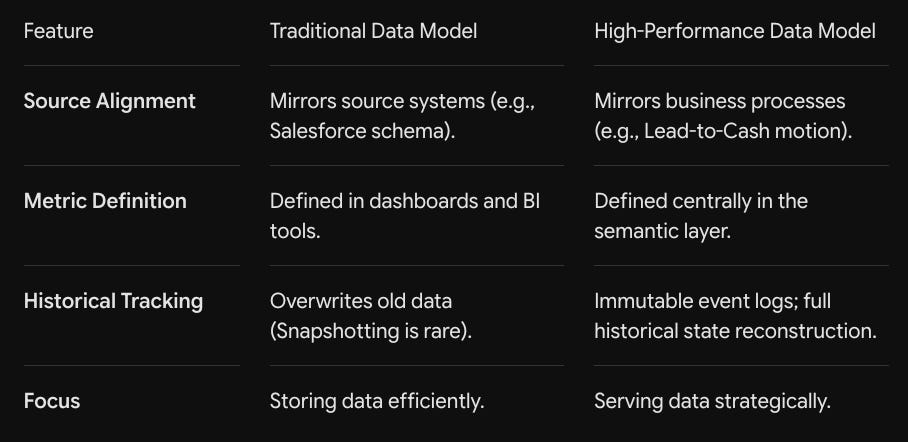
Traditional data modeling often falls into the trap of reflecting the software rather than the business. Engineers build models that mimic the schema of Salesforce, HubSpot, or NetSuite. This is a critical error. The CRM is just a tool; it is not the business itself.
A high-performance data model abstractions away from the source systems and aligns entirely with the fundamental mechanics of how your company generates value.
Key Attributes of Business Fidelity:
Entity Resolution: Clearly defining what a “Customer” “Booking” or “Subscription” is across the entire enterprise. A lead in marketing must logically flow into an opportunity in sales, and seamlessly map to recognized revenue in the ERP.
Event-Driven Granularity: Capturing business events (e.g., “Contract Signed” “Feature Activated” “Invoice Sent”) immutably. State changes are just as important as the current state.
Metric Standardization: Defining core RevOps metrics including Net Revenue Retention (NRR), Customer Acquisition Cost (CAC), and Annual Recurring Revenue (ARR) at the data model layer, not in the BI tool. This ensures absolute consistency regardless of how the data is queried.
Traditional vs. High-Performance Modeling
When evaluating tech architectures from an investment perspective, this is the first thing I look for.
A company that models its business accurately in its data layer possesses a massive competitive moat because it can pivot, measure, and scale with frictionless precision.
2. Agentic Extensibility (Structuring Data for AI)
We are rapidly transitioning from analytical dashboards to agentic workflows. In the agent operating systems I design for family offices and professional services, AI does not just summarize data; it takes action. It negotiates contracts, flags arbitrage opportunities, and autonomously drafts targeted outreach.
However, AI cannot act intelligently if the data logistics are broken. Large Language Models and autonomous agents interact with data differently than a traditional SQL analyst.
A high-performance data model must be built with “Agentic Extensibility” in mind.
